How Cabling Impacts Cybersecurity More Than Most Businesses Realize
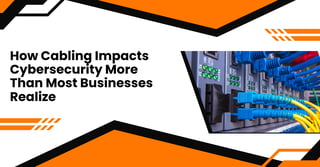
Most organizations invest heavily in firewalls, antivirus tools, and cloud security protections. Those investments matter, but they overlook a foundational layer that quietly shapes how secure your environment truly is: your cabling infrastructure.
At Total Communications, we spend every week inside businesses across Connecticut and beyond. We see the same pattern repeat itself. Companies assume cybersecurity threats come only from software or the internet, when in reality many issues begin inside the building walls, ceiling spaces, and wiring closets.
Strong cybersecurity is built on strong cabling. Here is why.
Cabling Affects Network Segmentation and Threat Containment. A secure network depends on proper segmentation. Guest Wi-Fi, building systems, VoIP, security cameras, and business-critical applications should not all sit on the same pathways. When all traffic shares the same cabling routes or unmanaged switches, it increases the surface area for attackers and reduces your ability to isolate threats.
A well-designed Cat6 or fiber cabling system allows you to separate departments, devices, and systems in a way that supports your firewall strategy rather than working against it. Poor cabling design often forces organizations to “combine everything” out of convenience, creating a single point of failure.
Physical Cabling Is the Front Line of Zero Trust
Zero Trust starts with the physical layer. If unused ports are active, patch panels are open, or abandoned cables remain connected to live equipment, unauthorized access becomes easier than most leaders expect.
During cabling assessments, we frequently find:
-
Active ports in open areas
-
Mislabeled or unlabeled cables leading to unsecured closets
-
Patch panels terminated incorrectly
-
Old cabling still connected to switches long after it should have been removed
Any of these conditions can undermine your cybersecurity posture before a firewall ever has a chance to do its job.
Bad Cabling Leads to Bad Device Behavior
Many cybersecurity alerts originate from devices that are not functioning correctly. Inconsistent connectivity can cause VoIP phones, workstations, or building systems to repeatedly reconnect, drop packets, or behave unpredictably. Security tools often flag these issues as suspicious activity.
In reality, the root cause is often a cabling problem such as:
-
Loose terminations
-
Damaged cable jackets
-
Exceeded distance limitations
-
Improperly placed low-voltage lines near electrical sources
When your cabling is unstable, your security logs become noisy and your teams waste time chasing false positives.
Cabling Impacts Your Ability to Detect and Respond to Threats
Modern cybersecurity tools rely on accurate, uninterrupted data flow. If your cabling can’t deliver reliable speed or bandwidth, you weaken your ability to monitor traffic, analyze threats, and respond quickly.
Fiber backbone cabling, for example, gives security systems the stability and throughput they need to analyze abnormal behavior in real time. Cat6 and Cat6A provide similar dependability for access-layer devices. When your cabling is outdated or inconsistent, you slow down your threat visibility, and every second matters.
A Secure Network Starts With the Infrastructure Behind the Walls
Cybersecurity is not just a software investment. It is a physical infrastructure investment. Organizations that combine both see stronger protection, fewer disruptions, and a more predictable security posture.
At Total Communications, we help businesses create cabling environments that support the speed, segmentation, reliability, and visibility cybersecurity teams depend on. If you want to know whether your current cabling is helping or hurting your defense strategy, we can help.
Schedule a Free Cabling and Security Infrastructure Assessment
If you’re unsure how much your cabling is affecting your security posture, Total Communications offers a free assessment that reviews both cabling and network design. We identify risks, prioritize what matters most, and outline practical steps to strengthen your foundation.
Visit TotalComm.com or contact our team to get started.